Subcontractor Certified Payroll: Who's Responsible
— WH347.io Team
Subcontractors on federal projects are just as responsible for Davis-Bacon compliance as general contractors — but many don't realize it until they're audited. Here's what every sub needs to know.
When a subcontractor wins work on a federal project, certified payroll compliance is rarely the first thing that comes to mind. Yet the Davis-Bacon Act applies to subs just as much as it applies to the general contractor — and the penalties for non-compliance fall on everyone in the chain. Understanding your obligations before work begins is far less painful than discovering them during an audit.
Does the Davis-Bacon Act Apply to Subcontractors?
Yes — unequivocally. The Davis-Bacon Act covers all contractors and subcontractors performing work on federally funded or federally assisted construction contracts valued at more than $2,000. The mechanism is a flow-down clause embedded in the prime contract. When the general contractor signs with the federal agency, they agree to pass prevailing wage requirements down to every subcontractor they hire. Those subs, in turn, must pass the same requirements down to their own lower-tier subs.
What Subcontractors Must Submit
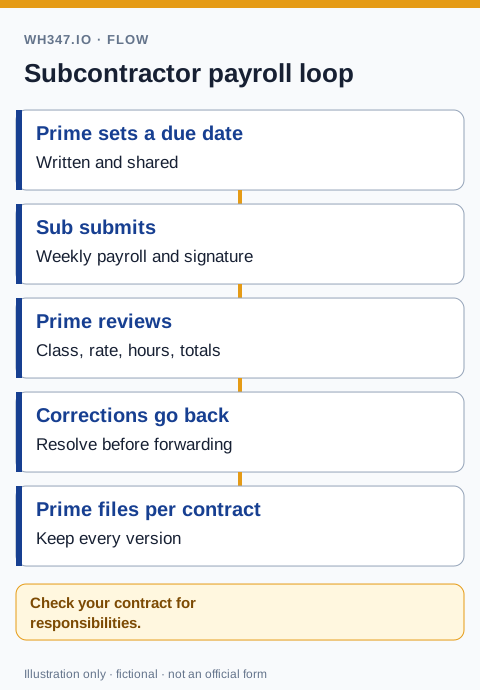
- Weekly certified payroll for every week covered work is performed. Confirm any additional no-work certification requirement with the prime and contracting agency.
- A signed Statement of Compliance on page 2 of the WH-347, certified by the contractor or an authorized representative.
- Certified payroll records submitted to the prime contractor, who is responsible for collecting them and forwarding to the contracting agency.
Who Is Responsible if a Sub Doesn't Comply?
29 CFR 5.5(a)(6)'s subcontract clauses establish flow-down requirements and prime responsibility. Use our no-work-week guidance to distinguish weekly covered-work reports from agency-specific negative payrolls, and the owner-operator coverage discussion and source caution when a sole proprietor works on site.
The prime contractor is ultimately liable to the contracting agency for compliance across the entire project — including every subcontractor they've hired. If a sub fails to submit certified payroll on time, underpays workers, or misclassifies employees, the prime can be held responsible, subjected to back wage assessments, and potentially debarred from future federal work. This is why most general contractors require subs to submit payroll records directly and maintain copies for their own records. As a sub, late or inaccurate submissions don't just put you at risk — they put your GC at risk too, which can damage the business relationship and cost you future contracts.
Lower-Tier Subcontractors
The flow-down requirement doesn't stop at first-tier subcontractors. If you hire your own sub to perform work on the project, that second-tier sub is also covered by the Davis-Bacon Act and must submit their own certified payroll. The prime contractor must ensure compliance all the way down the chain, and each employer in the chain must submit payroll independently for their own workers. A second-tier sub cannot simply be folded into your WH-347 — they are a separate legal employer and must file separately.
Fringe Benefits for Subcontractors
Prevailing wage requirements include both base wages and fringe benefits. If the applicable wage determination for your project and trade classification requires a fringe benefit — health insurance, pension contributions, vacation pay — you must provide it. If you don't offer those benefits, you must pay the cash equivalent on top of the base wage rate. This catches many small subs off guard: paying the base wage rate alone is not sufficient if the wage determination includes a fringe component.
Common Mistakes Subcontractors Make
- Assuming the GC handles all certified payroll — they don't. Each employer submits their own WH-347 for their own workers.
- Using the wrong wage determination — the GC should provide the applicable determination tied to the federal contract. If they don't, ask for it before work begins.
- Missing required 'no work performed' certifications — follow the contract or agency's no-work reporting instructions rather than assuming one universal procedure.
- Misclassifying workers — a laborer performing carpentry work must be paid at the carpenter's prevailing wage rate, not the laborer rate. Classification follows the work, not the job title.
- Failing to account for fringe benefits — check the wage determination for fringe requirements and make sure your wage calculation includes them.
How WH347.io Helps Subcontractors
WH347.io is built for exactly this situation. As a subcontractor, you set up your own organization, add your employees with their Davis-Bacon classifications, and enter weekly timecards for each project. The system generates WH-347 PDFs that are ready to hand to the prime contractor — complete, accurate, and properly formatted. No spreadsheets, no manually filling in government forms, no risk of arithmetic errors on the wage calculations. When the prime asks for your certified payroll, you have it ready in minutes.
Certified payroll compliance as a sub isn't optional, but it doesn't have to be complicated. Getting the process right from day one protects you, protects your GC, and ensures you stay eligible for federal work — which is exactly where the steady, long-term contracts are.
Frequently Asked Questions
Does the Davis-Bacon Act apply to subcontractors?
Yes. The Davis-Bacon Act applies to all contractors and subcontractors on federally funded or federally assisted construction contracts over $2,000. A flow-down clause in the prime contract passes prevailing wage requirements down to every subcontractor, and each sub must pass those requirements to their own lower-tier subs.
What certified payroll forms must subcontractors submit?
Subcontractors must submit a WH-347 form for every week workers are on site, including weeks with zero work (filed as 'no work performed'). Each submission must include a signed Statement of Compliance. Reports are submitted to the prime contractor, who forwards them to the contracting agency.
Who is liable if a subcontractor fails to comply with Davis-Bacon?
The prime contractor is ultimately liable to the contracting agency for compliance across the entire project, including all subcontractors. A sub's late or inaccurate filings put both the sub and the general contractor at risk of back-wage assessments and potential debarment from future federal work.
Do lower-tier subcontractors need to file their own certified payroll?
Yes. Each employer in the contracting chain must file their own WH-347 for their own workers. A second-tier subcontractor cannot be folded into the first-tier sub's report — they are a separate legal employer and must submit certified payroll independently.