Prevailing Wage Certified Payroll: Contractor Guide
— WH347.io Team
Prevailing wage certified payroll is the system that keeps federal construction contracts honest. Here's exactly how prevailing wages work, how to report them on the WH-347, and what happens if you get it wrong.
Prevailing wage certified payroll is the combination of two federal requirements that every contractor on a government-funded construction project must meet: paying workers at least the prevailing wage rate for their trade and locality, and documenting that payment each week on a certified payroll report. Miss either piece — the right wage or the proper documentation — and you're out of compliance.
Most contractors understand prevailing wage in the abstract but struggle with the specifics: how exactly do wage rates apply to different work classifications, how do fringe benefits factor in, and what does the WH-347 certified payroll form actually require you to report? This guide answers all of it.
What Is Prevailing Wage Under the Davis-Bacon Act?
The Davis-Bacon Act, originally passed in 1931, requires that laborers and mechanics employed on federal construction contracts over $2,000 be paid no less than the locally prevailing wage for their type of work. The Department of Labor's Wage and Hour Division (WHD) determines prevailing wages through wage surveys and publishes them in wage determinations that are incorporated into each contract.
Prevailing wage is not a single national number. It varies by trade and by geography — a journeyman electrician in Dallas has a different prevailing wage than a journeyman electrician in Boston. It also varies by classification: a laborer rate is different from a carpenter rate, which is different from an operating engineer rate. You must apply the correct rate for the work each employee actually performs each day.
How Prevailing Wage Rates Are Structured
Every wage determination contains two components for each classification: a basic hourly rate and a fringe benefit rate. The basic hourly rate is the minimum cash wage that must be paid directly to the worker. The fringe benefit rate is an additional amount that must be provided either as bona fide fringe benefits (health insurance, pension, vacation, etc.) or as additional cash wages.
For example, if the wage determination shows Carpenter: $32.00 basic + $14.50 fringe, you must pay at least $32.00 per hour in cash wages and provide at least $14.50 per hour in bona fide fringe benefits. If you don't offer fringe benefits, you must pay the full $46.50 per hour in cash. You cannot substitute a less expensive benefit package and pocket the difference.
- Basic hourly rate: the minimum cash wage paid directly to the worker for each hour worked.
- Fringe benefit rate: must be provided as bona fide benefits (health, pension, vacation) or additional cash.
- Total prevailing wage: basic rate + fringe rate — the floor for all-in compensation.
- Overtime: Davis-Bacon requires overtime pay at 1.5x the basic rate for hours over 40 in a week, per the Contract Work Hours and Safety Standards Act (CWHSSA).
How to Report Prevailing Wages on the WH-347
DOL Fact Sheet 66 explains the basic-rate-plus-fringe obligation. Apply it using our cash and bona fide plan reporting examples and trade-switching time records, then reconcile the figures to the contract's determination.
The WH-347 certified payroll form is the reporting mechanism for prevailing wage compliance. Each row on the form covers one worker's hours and pay for the week. For prevailing wage purposes, the most critical columns are work classification, hourly rate paid, fringe benefits, and gross wages.
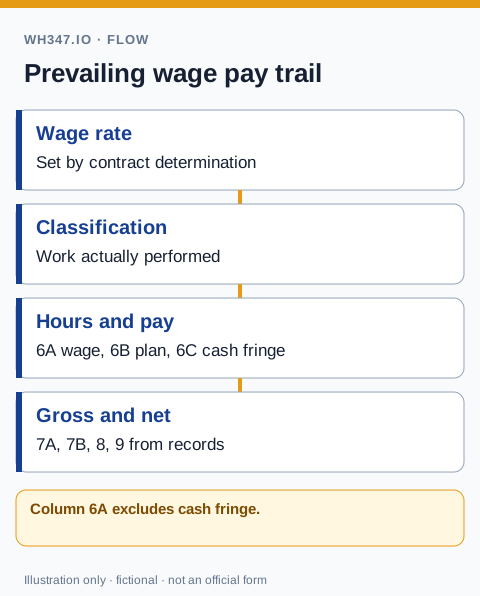
Work classification (Column 3) must match the wage determination exactly — you cannot use internal job titles. If someone pours concrete, they're a Cement Mason, not a 'field worker.' If someone operates a forklift, they're classified as an Operating Engineer for those hours, regardless of their employment title. Classification follows the work performed, not the employee's job description.
Column 6A reports actual straight-time and overtime hourly wage rates, excluding cash in lieu of fringe, and must meet the applicable basic wage requirement. Column 6B reports the pay-period plan-credit total; Column 6C reports the total cash-in-lieu payment. Page-two box 5 details hourly plan credits. Include cash fringe in project gross earnings in 7A and applicable all-work gross earnings in 7B, but exclude noncash plan credits from gross cash wages.
Common Prevailing Wage Mistakes on Certified Payroll
- Wrong classification: using the laborer rate for a worker doing carpentry. Classification follows the work — a worker doing two trades in the same week must be listed on two separate lines at two different rates.
- Using outdated wage determinations: rates are updated periodically. Always use the wage determination incorporated into your specific contract, and check for modifications.
- Ignoring fringe benefits: paying only the basic rate and forgetting that fringe benefits are also required. If you don't offer a qualifying plan, the fringe rate must be paid as additional cash wages.
- Misreporting overtime: Davis-Bacon overtime is based on hours over 40 in a work week, not daily overtime. Overtime is calculated on the basic rate only, not the fringe rate.
- Apprentice rate errors: apprentices must be registered with a DOL-approved program and paid according to the program's approved wage schedule — not automatically at a lower fraction of journeyman rates.
What Happens If You Underpay Prevailing Wages?
The consequences for prevailing wage violations are serious and escalate quickly. At the first level, the contracting agency will demand back wages — you must make up the difference between what was paid and the required prevailing wage for every affected worker and every affected week. Back wages can accumulate fast on a multi-month project with a full crew.
For willful or repeated violations, the DOL can recommend debarment — a ban from federal contracting for up to three years. Debarred contractors and their principals are listed on the System for Award Management (SAM) and cannot bid on any federally funded work during that period. For many construction firms, that is effectively a death sentence.
Criminal penalties are also possible for falsification of certified payroll records. Knowingly submitting a WH-347 that misrepresents wages paid is a federal offense under 18 U.S.C. § 1001, carrying fines and up to five years imprisonment.
How WH347.io Helps With Prevailing Wage Compliance
WH347.io is built around the certified payroll workflow. You enter each employee's work classification and hours, and the platform automatically calculates gross wages, overtime, and deductions. The WH-347 form is generated in the current DOL format with all prevailing wage fields properly populated — including the Statement of Compliance that certifies wages were paid correctly.
WH347.io offers California eCPR and AASHTOWare-targeted XML exports from the same timecard data. Check the receiving agency's required schema, identifiers, and certification process before submission; an export option does not prove agency acceptance.
Frequently Asked Questions
What is prevailing wage certified payroll?
Prevailing wage certified payroll is the combination of two federal requirements: paying workers at least the locally prevailing wage rate for their trade (set by the Davis-Bacon Act), and reporting that payment weekly on a certified payroll form (WH-347). Both requirements apply to contractors and subcontractors on federally funded construction projects.
Who sets prevailing wage rates for federal construction projects?
The U.S. Department of Labor's Wage and Hour Division (WHD) sets prevailing wage rates through wage surveys. Rates vary by trade, work classification, and geographic area. The DOL publishes them in wage determinations that are incorporated into each federal construction contract. You can find current wage determinations at sam.gov.
How do I report prevailing wages on the WH-347 form?
Report the work classification and daily hours, actual ST/OT hourly wages in 6A excluding cash fringe, total plan credit in 6B and total cash in lieu in 6C. Include cash fringe in project gross earnings in 7A and applicable all-work gross earnings in 7B; report actual all-work deductions and net pay in 8 and 9. Identify J or RA with progression in Column 2, and use separate classification rows for different trades.
Do fringe benefits count toward prevailing wage?
Yes. The prevailing wage consists of a basic hourly rate plus a fringe benefit rate. You can satisfy the fringe portion by contributing to bona fide benefit plans (health insurance, pension, vacation, etc.) or by paying the fringe amount as additional cash wages. You cannot use a cheaper benefit package and keep the difference — the full fringe rate must be accounted for.
What are the penalties for prevailing wage violations on certified payroll?
Penalties include back wage restitution for all affected workers, contract termination, and debarment from federal contracting for up to three years. Knowingly falsifying a WH-347 to hide underpayment is a federal crime under 18 U.S.C. § 1001, punishable by fines and up to five years in prison.