Certified Payroll Fringe Benefits: Cash vs. Bona Fide Plan
— WH347.io Team
The prevailing wage includes a basic hourly rate and a fringe benefit rate. Report plan credits and cash in lieu separately in Columns 6B and 6C, and reconcile cash payments to gross earnings.
Every wage determination under the Davis-Bacon Act includes two components: a basic hourly rate and a fringe benefit rate. Together, they constitute the prevailing wage — the floor that contractors must meet for each covered classification. But meeting the fringe benefit requirement can be done in two fundamentally different ways, and the WH-347 form is structured to capture both. Getting the distinction right isn't just a form-filling detail — it determines whether you're actually in compliance.
The Two Ways to Satisfy the Fringe Requirement
Under 29 CFR § 5.26, contractors can satisfy the fringe benefit requirement on a Davis-Bacon project in two ways:
- Bona fide plan contributions: contribute the required fringe amount per hour to a bona fide benefit plan — health insurance, pension or retirement fund, vacation accrual, apprenticeship fund, or other qualifying benefits. The plan must meet DOL standards for being 'bona fide.'
- Cash in lieu: pay the fringe amount as additional cash wages directly to the worker, on top of the basic hourly rate. The worker receives the full prevailing wage in cash — basic rate plus the fringe amount — with no benefit plan involved.
A contractor can use both methods simultaneously — paying fringe for some workers through a plan and for others in cash, or even splitting a single worker's fringe requirement between a partial plan contribution and a cash supplement if the plan contribution doesn't fully cover the required fringe rate.
What Makes a Plan 'Bona Fide'?
The DOL's standards for a bona fide benefit plan are set out in 29 CFR § 5.26. In summary, a plan is bona fide if it:
- Is a legally established plan, fund, or program — not an informal arrangement or a promise of future benefits.
- Provides genuinely valuable benefits — health insurance, retirement, vacation, sick leave, life insurance, disability insurance, or similar.
- Does not allow the contractor to recapture contributions for their own use.
- Involves actual, irrevocable contributions to a fund or insurance arrangement — not just a bookkeeping entry.
- Covers workers without excessive eligibility restrictions that effectively exclude most of the workforce.
If your benefit plan is administered through a union trust fund, it almost certainly qualifies. If you're offering company-sponsored health insurance through a commercial carrier, it generally qualifies. If you're offering a 401(k) with employer contributions, it generally qualifies. Informal arrangements — 'we give workers a gas stipend' or 'we pay for their tools' — do not qualify as bona fide fringe benefits.
How to Report Each Method on the WH-347
For the current form, follow the DOL's Column 6B, Column 6C and page-two instructions: report pay-period plan credits and cash-in-lieu totals separately, with hourly plan detail on page two. Our current field examples and certification guide connect those amounts to the signed report.
The current WH-347 separates the hourly wage, plan-credit total, cash-in-lieu total, and gross earnings:
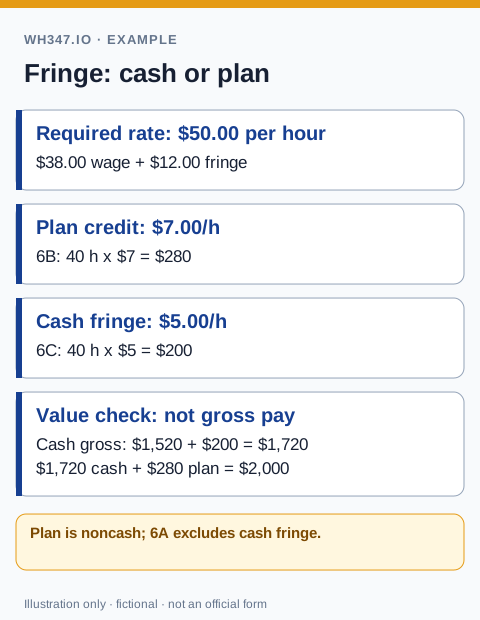
- Column 6A: Enter actual straight-time and overtime hourly wage rates, excluding cash paid in lieu of fringe benefits.
- Column 6B: Enter the total credit for bona fide plan contributions or approved reasonably anticipated costs for the pay period, not the hourly plan rate. Detail the hourly credit for each worker and plan in page-two box 5.
- Column 6C: Enter total cash paid in lieu of fringe benefits for the workweek, not an hourly rate.
- Columns 7A and 7B: Include cash-in-lieu payments in project gross earnings in 7A and, when the worker also earned wages elsewhere, in all-work gross earnings in 7B. Do not include noncash plan credits in gross cash wages.
- Statement of Compliance: Boxes 1, 2, 3 and 6 must always be checked for a covered-work payroll. Check box 4 when apprentices are paid and supply the program details. Check box 5 for plan credits and complete the hourly-credit table; for cash-only fringe, check box 5 but leave that table unfilled and report the payment in 6C.
Fictional example: a worker earns $32/hour in basic wages for 40 straight-time hours, with a required $14/hour fringe. A $8/hour qualifying plan credit plus $6/hour cash supplement gives 6A = $32, 6B = $320, 6C = $240 and 7A = $1,520. If the worker also earns $200 on another job, 7B = $1,720. Page-two box 5 details the $8 hourly plan credit. With cash-only fringe, 6B = $0, 6C = $560 and 7A = $1,840; 6A remains $32, and box 5 is checked without completing the plan table.
The Compliance Risk of Getting It Wrong
Fringe benefit reporting errors are one of the most common findings in Davis-Bacon compliance audits. The most frequent patterns:
- Reporting plan fringe on the WH-347 but not actually making the contributions — claiming credit for a bona fide plan that isn't receiving the required contributions is both a wage violation and a false certification.
- Claiming the full fringe rate as a plan contribution when the plan only covers part of it — if your health plan contribution is $8/hour but the required fringe rate is $14/hour, the remaining $6/hour must either be covered by other qualifying benefits or paid as cash wages.
- Omitting cash-in-lieu fringe from Column 6C or gross earnings — cash fringe must be reported separately as a total and included in gross cash wages.
- Using a non-qualifying benefit to satisfy the fringe requirement — informal arrangements, personal expenses, or one-time bonuses don't count toward the prevailing wage fringe.
Annualization of Fringe Benefit Plans
29 CFR 5.25(c)'s annualization rule generally divides creditable costs by hours on both private and DBRA-covered work, with specified exceptions. Keep the calculation for each worker and benefit rather than dividing only by covered-project hours.
If your benefit plan costs are paid on an annual basis (e.g., annual health insurance premiums), the DOL allows you to annualize — calculate a per-hour credit by dividing the annual plan cost by the total hours worked in the year. This is called the 'annualization' method. The resulting per-hour credit can be applied against the prevailing wage fringe requirement on Davis-Bacon projects.
Annualization requires a careful calculation and good documentation. The DOL has specific guidance on how to perform it correctly. If your plan costs change mid-year (new insurance renewal, employee additions or departures), the per-hour credit should be recalculated. This is an area where working with a labor compliance specialist or a knowledgeable attorney can prevent errors.
Frequently Asked Questions
What are the two ways to satisfy the Davis-Bacon fringe benefit requirement?
Contractors can satisfy the fringe requirement by (1) contributing the required per-hour fringe amount to a bona fide benefit plan (health insurance, pension, vacation, etc.) or (2) paying the fringe amount as additional cash wages directly to the worker, known as 'cash in lieu.' Both methods, or a combination, are allowed under 29 CFR § 5.26.
How do bona fide plan fringe benefits appear on the WH-347?
Enter the pay-period plan-credit total in Column 6B, not an hourly rate. Check page-two box 5 and detail each worker's hourly credit and plan information in its table. Noncash plan credits are not included in gross cash wages in 7A or 7B. Boxes 1, 2, 3 and 6 are always required for a covered-work payroll; box 4 applies when apprentices are paid.
How does cash-in-lieu fringe appear on the WH-347?
Report the total cash-in-lieu payment in Column 6C and include it in project gross earnings in 7A and applicable all-work gross earnings in 7B. Exclude it from the hourly wage rate in 6A. For cash-only fringe, check page-two box 5 but do not complete its plan-credit table. For a plan-and-cash combination, report the plan-credit total in 6B and detail its hourly credit in box 5.
What makes a benefit plan 'bona fide' for Davis-Bacon purposes?
A bona fide plan is a legally established, irrevocable arrangement that provides genuine benefits (health insurance, retirement, vacation, etc.) to workers, without allowing the contractor to recapture contributions. Union trust funds, commercial health insurance plans, and 401(k) with employer contributions generally qualify. Informal arrangements, gas stipends, and one-time bonuses do not.
What happens if I claim a plan fringe credit but don't actually make the contributions?
Claiming credit for plan fringe contributions that were not actually made is both a wage violation and a false statement on the WH-347's Statement of Compliance. The DOL can require back wages for the shortfall, and knowingly making false certifications is a federal offense under 18 U.S.C. § 1001.