How to Fill Out the WH-347 Form: 2026 Instructions
— WH347.io Team
A field-by-field guide to using the optional WH-347 form to present required weekly payroll information on covered federal construction contracts.
Reviewed for the current DOL form: Checked September 8, 2026 by the WH347.io compliance content team against the U.S. Department of Labor's Government Contracts forms page, Form WH-347 and its instructions, and the controlling certified-payroll requirement in 29 C.F.R. § 5.5(a)(3)(ii). The form reviewed is Rev. January 2025, OMB Control No. 1235-0008, and expires January 31, 2028. Your contract and contracting agency's instructions also control how and where you submit.
Free field checklist: Open the one-page printable WH-347 field checklist. It is ungated and uses fictional examples, so you can print it or save it as a PDF for your payroll review file.
On a covered federal or federally assisted construction contract, contractors and subcontractors must submit required payroll information every week. The Department of Labor makes Form WH-347 available as an optional form for presenting that information; a contractor may use another format if it contains all information required by 29 C.F.R. § 5.5(a)(3)(ii) and the contracting agency accepts it.
This guide walks through every section of the currently published form and flags the entries that most often require a second look. Always compare your report with the wage determination incorporated into your contract and any agency-specific submission instructions.
Header Information
The top of the current form identifies whether the filer is the prime contractor or a subcontractor and asks for the business name and address, project name and location, project or contract number, wage determination number and revision, sequential certified payroll number, and week-ending date. Match these entries to the covered contract and agency records.
Column-by-Column Breakdown
- Columns 1A–1E (Worker): Sequential worker entry number, last name, first name, middle initial, and an individual identifying number such as the last four digits of the SSN. Never enter a full SSN.
- Column 2 (Journeyworker / Registered Apprentice): Enter J or RA. For a registered apprentice, also list the worker's level of progression in the approved program.
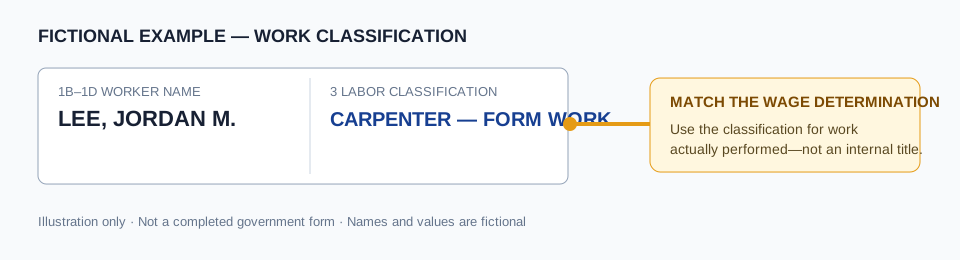
- Column 3 (Labor classification): Use the classification for the work actually performed from the wage determination incorporated into the contract. Use separate rows when a worker performs more than one classification.
- Column 4 (Hours worked each day): Enter straight-time and overtime hours for each day, using the top ST row and bottom OT row.
- Column 5 (Total hours worked): Total the straight-time and overtime hours for the week.
- Column 6A (Hourly wage rate paid): Report the actual hourly rate paid for straight time and overtime, excluding cash paid in lieu of fringe benefits.
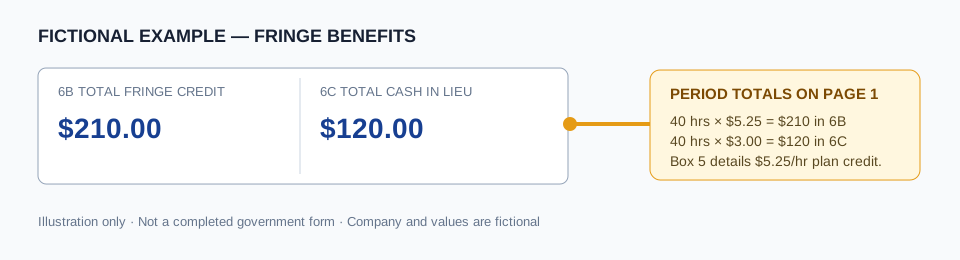
- Column 6B (Total fringe-benefit credit): Report the total plan credit for the pay period—not an hourly rate. It should equal total hours worked in the period multiplied by the total hourly credit detailed in box 5 on page 2.
- Column 6C (Payment in lieu of fringe benefits): Report the total cash-in-lieu amount paid for the workweek—not an hourly rate.
- Columns 7A and 7B (Gross earnings): Report gross earnings for work on this federal or federally assisted project in 7A and gross earnings for all work performed during the week in 7B.
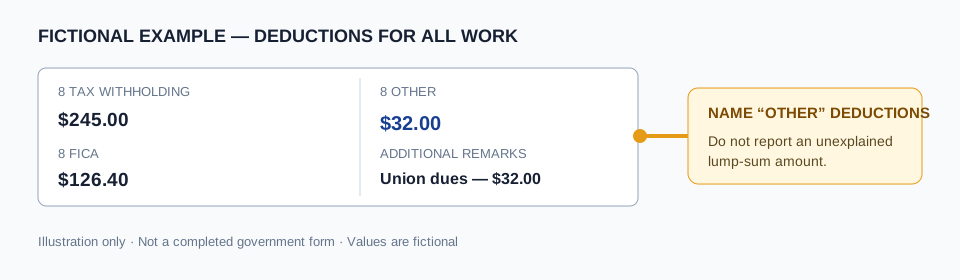
- Column 8 (Deductions for all work): Break out tax withholding, FICA, and Other deductions; then report total deductions. Describe a single Other deduction in Additional Remarks, or attach an itemized addendum when Other combines multiple deductions.
- Column 9 (Net payment for all work): Report the actual amount paid to the worker for all hours worked across all projects during the week.
The Statement of Compliance
If a worker changes trades during the week, use the multi-classification reporting examples to reconcile the separate rows. Then review who signs the Statement of Compliance against the current DOL instructions cited above.
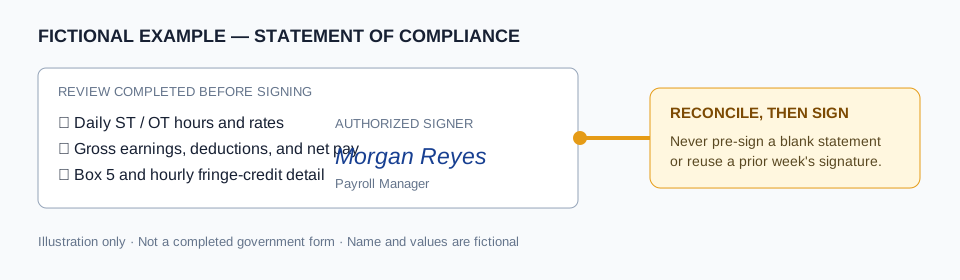
Page 2 of the WH-347 is the Statement of Compliance — a legal certification signed by the contractor or an authorized representative. By signing, you're certifying that the payroll is correct and complete, that wages paid meet Davis-Bacon requirements, and that fringe benefits have been paid. This signature carries legal weight, so ensure the figures on page 1 are accurate before signing.
Annotated Fictional Examples for High-Risk Fields
Work classification — fictional entry: “Carpenter — Form Work” for Jordan Lee. Why: use the classification that describes the work actually performed and appears in the project's applicable wage determination; do not substitute an internal job title such as “Crew II.” If Jordan performs work in more than one classification, report the hours separately unless the higher applicable rate is paid for all hours.
Fringe benefits — fictional entry: Jordan worked 40 hours and the wage determination requires $8.25/hour in fringe benefits. Acme Builders claims a $5.25/hour bona fide-plan credit and pays $3.00/hour in cash. Page 1 therefore shows $210.00 total in column 6B and $120.00 total in column 6C; page 2 box 5 details the $5.25 hourly plan credit. Why: columns 6B and 6C require pay-period totals, while the plan detail on page 2 uses hourly credit amounts.
Deductions — fictional entry: column 8 shows FICA $126.40; tax withholding $245.00; and Other $32.00, with “Union dues — $32.00” identified in Additional Remarks. Why: identify Other deductions rather than leaving an unexplained amount. Confirm every deduction is permitted under 29 C.F.R. part 3 and obtain DOL approval when required.
Statement of Compliance — fictional entry: Morgan Reyes, Payroll Manager, signs only after reconciling Jordan Lee's daily hours, rates, gross pay, deductions, net pay, and fringe treatment to payroll records. Because Acme claims a plan credit, box 5 is checked and the hourly fringe-credit subsection is complete. Why: the signer must know the certified facts; do not pre-sign a blank statement or use a photocopied or scanned signature.
Current Form Version
As checked on September 8, 2026, the DOL-published WH-347 is marked Rev. January 2025, displays OMB Control No. 1235-0008, and expires January 31, 2028. Download the form from the DOL forms page rather than relying on an old local copy, and compare all three identifiers before use.
Common Mistakes to Avoid
- Using the wrong wage determination for the project location or type of work.
- Missing overtime — any hours over 40 per week must be compensated at 1.5× the base rate.
- Failing to account for fringe benefits — if you pay cash in lieu of benefits, that amount must be included in the wage calculation.
- Submitting late — most contracts require weekly submission within 7 days of the pay period ending.
- Leaving fields blank instead of writing 'N/A' or '0.'
Streamline the Process with Software
If you need a blank government template, start with the official WH-347 fillable form and version guide. For recurring weekly work, the WH347.io certified payroll generator reuses employee, project, timecard, and wage data to produce completed reports and retain payroll history.
Editorial Policy, Scope, and Update History
Update policy: the WH347.io compliance content team re-checks this guide when the DOL publishes a new WH-347, changes its instructions or Davis-Bacon certified-payroll guidance, and at least annually. Material corrections are dated below. If an official source conflicts with this guide, follow the official source and your contracting agency's instructions.
Scope: this guide is general educational information, not legal advice, a wage determination, or a substitute for your contract. Requirements can vary by funding source and agency. Ask the contracting agency or qualified counsel about a project-specific question.
- September 8, 2026: Re-checked the current DOL form and regulation; clarified that weekly payroll information is required while use of WH-347 is optional; corrected the OMB-version explanation; and added source links, review provenance, fictional high-risk field examples, and the printable checklist.
- July 29, 2026: Updated the guide's 2026 form-version discussion and related instructions.
- May 7, 2026: First published.
Frequently Asked Questions
What is the WH-347 form used for?
WH-347 is an optional Department of Labor form contractors may use to present the weekly payroll information required on covered federal or federally assisted construction contracts. Contractors may use another format if it contains all information required by 29 C.F.R. § 5.5(a)(3)(ii) and the contracting agency accepts it.
What is the Statement of Compliance on the WH-347?
The Statement of Compliance is a legal certification on page 2 of the WH-347 signed by the contractor or authorized representative. By signing, you certify that the payroll is accurate, wages meet Davis-Bacon requirements, and fringe benefits have been properly paid. It carries full legal weight and false statements can result in criminal penalties.
How often must certified payroll information be submitted?
On covered contracts, required payroll information must be submitted weekly. WH-347 is an optional form for presenting that information; contractors should follow their contract and contracting agency's instructions for format, timing, and submission.
What are the most common mistakes when filling out the WH-347?
Common errors include using the wrong wage determination for the project location, failing to report overtime hours at 1.5× the base rate, not accounting for fringe benefits or cash-in-lieu payments, submitting late, and leaving required fields blank rather than entering zero or N/A.