Certified Payroll Record Retention: How Long to Keep Your Records
— WH347.io Team
Keep federal DBRA records during the work and for at least three years after all prime-contract work ends. Learn what to preserve, who has agency access, and how to check longer state, grant, contract, or preservation obligations.
Recordkeeping does not end when your subcontract finishes or final payment clears. Federal DBRA contract provisions require basic records and certified payrolls to be preserved during the work and for at least three years after all work on the prime contract is completed. Authorized agency and DOL representatives have inspection and copying rights; this provision does not establish a general worker right to inspect other workers' payroll records.
What goes into 'payroll records' is broader than most contractors expect. And for projects in states with their own prevailing wage laws, the retention period and document list can extend further. Getting the retention program right before a project ends — while the records are still easy to organize — is significantly easier than trying to reconstruct them two years later when an audit inquiry arrives.
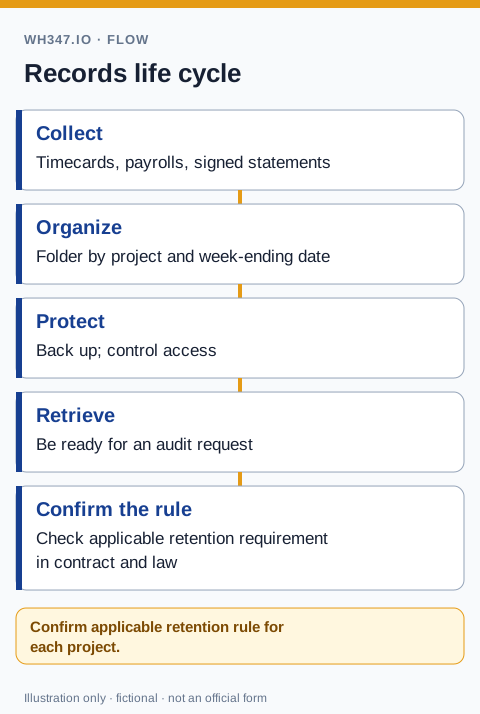
The Federal Three-Year Rule
Under 29 CFR 5.5(a)(3), the federal retention clock runs from completion of all work on the prime contract, not from a payroll submission, final payment, or completion of an individual subcontract. If all prime-contract work finishes in March 2026, retain the covered records until at least the corresponding date in March 2029. Longer applicable requirements or a preservation hold can extend that date.
Section 5.5(a)(3)(iv) requires records to be available for inspection, copying, or transcription by authorized agency and DOL representatives, and requires access for those representatives to interview workers during working hours. Any employee-access rights under other laws must be checked separately. Protect full Social Security numbers and contact details; they belong in underlying records, not weekly agency transmittals.
What Records Must Be Kept
The Davis-Bacon regulations specify a minimum set of records that must be retained for each covered employee:
- Name, full Social Security number, and last known address, telephone number, and email address of each covered worker in underlying records; omit full SSNs and contact details from weekly transmittals.
- Each worker's correct work classification(s) on the project.
- Wage rates paid — both the basic hourly rate and the fringe benefit rate.
- Daily and weekly hours actually worked in total and on each covered contract, including time in each classification.
- Gross wages earned.
- Deductions from wages — federal and state income tax, FICA, and any other deductions.
- Net wages paid.
- Fringe benefit plan documentation — written plan documents, trust agreements, or evidence of bona fide fund contributions for each employee covered by a plan.
- Copies of submitted WH-347 certified payroll reports.
- Signed Statements of Compliance for each required certified payroll.
- Apprenticeship program and individual registration evidence, applicable ratios, and wage rates when apprentices are used.
- Contracts, subcontracts, and related bids, proposals, amendments, modifications, and extensions.
Keep copies of all submitted WH-347 forms, not just the underlying payroll data. If you submitted corrected payrolls, keep both the original and the corrected versions, along with a note explaining what was corrected and why.
Fringe Benefit Plan Documentation
29 CFR 5.5(a)(3)'s recordkeeping provisions specify payroll, fringe-plan and apprenticeship evidence. Use the audit records checklist to organize it, and retain the calculations described in our cash-versus-plan fringe guide with the weekly reports.
Fringe benefit documentation is an area where many contractors are under-documented. If you pay fringe benefits into a bona fide plan — health insurance, pension, apprenticeship fund — you need to be able to demonstrate two things: that the plan qualifies as bona fide under DOL standards, and that you actually contributed the required amounts on behalf of each worker.
Documentation should include: the plan document or summary plan description, proof of contributions (remittance statements, insurance premium invoices, fund contribution reports) for each payroll period, and evidence that contributions were made on behalf of the workers listed on the WH-347. These records must be maintained for the full three-year retention period.
State-Level Retention Requirements
The federal three-year rule is not a substitute for checking state law, grant conditions, and your contract. Those requirements may use different record categories, start dates, or longer periods. This guide does not provide a verified state-by-state retention schedule; obtain the applicable statute and agency instructions before setting a destruction date.
- Identify every applicable federal, state, local, and grant recordkeeping requirement.
- Record each source's required period, triggering event, record categories, and access obligations.
- Use the latest applicable destruction date rather than assuming every period starts at project completion.
- Suspend routine destruction when an investigation, dispute, or legal preservation obligation requires records to be held.
- Confirm uncertain requirements with the awarding agency or qualified counsel and keep the written answer.
Best Practices for Digital Record Retention
Paper-based record retention for multi-year federal projects is error-prone and space-intensive. Digital retention is both acceptable and preferable, provided a few conditions are met: records must be legible (scanned documents at adequate resolution), complete (no missing weeks), and retrievable within a reasonable time if requested by an auditor.
- Store certified payroll records by project and by week — a folder structure that mirrors your project list and payroll schedule makes retrieval fast when an inquiry arrives months later.
- Include signed Statements of Compliance in the same folder as the corresponding WH-347 — auditors expect them together.
- Back up digital records in at least two locations (cloud storage plus local backup). Losing records because of a hard drive failure is not a defense in an audit.
- Document your retention schedule in writing — know when each project's three-year (or longer) window expires and have a process for confirming records are still accessible as the window closes.
- When project records are purged after the retention period expires, document the purge — a log showing that records were maintained through the required window and then properly destroyed.
Use WH347.io's project and timecard data to prepare reports, but maintain your own archive of the exact submitted reports, signed certifications, and supporting records. Do not assume an account or a newly generated PDF preserves a historical signed submission or guarantees statutory retention.
Frequently Asked Questions
How long do certified payroll records need to be kept?
Keep federal DBRA records during the work and for at least three years after all work on the prime contract is completed, not from an individual payroll or subcontract completion. Check state law, grant and contract requirements, and preservation holds for any longer or differently triggered obligation.
What records must be retained for Davis-Bacon compliance?
Keep worker identity and contact details in underlying records, classifications, rates, daily and weekly hours in total and by covered contract, deductions and wages paid, fringe evidence, apprenticeship records, certified payrolls with signed compliance statements, and contracts and related documents. Full SSNs and contact details must not appear on weekly agency transmittals.
Can certified payroll records be stored digitally?
Yes. Digital retention is acceptable under Davis-Bacon regulations, provided records are legible, complete, and retrievable within a reasonable time. Back up digital records in at least two locations, and organize them by project and payroll week so you can respond to an audit inquiry without searching through unstructured files.
Do fringe benefit plans need to be documented separately?
Yes. If you credit fringe benefits paid into a bona fide plan against the prevailing wage requirement, you must retain plan documents (summary plan description or trust agreement) and proof of contributions for each worker and each payroll period. These records must be kept for the full three-year retention period.
What happens if I can't produce certified payroll records during an audit?
Section 5.5(a)(3)(iv) provides for suspension of payments after written notice and possible debarment for failure to supply records or permit required access. Records not provided to WHD within its requested time can be excluded from a later administrative proceeding. WHD considers reasonable extension requests; request one promptly if needed.