What Happens If You Submit the Old WH-347 After September 30?
— WH347.io Team
Five weeks until the deadline. After September 30, contracting agencies must reject any WH-347 submitted on the old form. Here's exactly what rejection means for your project — delayed payments, compliance flags, and how to recover if it happens to you.
Source caution — checked October 5, 2026: The September 30/October 1 rejection deadline and March 2029 replacement-form date asserted in this historical article are not supported by the current DOL instructions. The published form is Rev. January 2025, OMB Control No. 1235-0008, expiring January 31, 2028. Use of WH-347 itself is optional; required weekly payroll information and a signed compliance statement are not. An OMB approval expiration date is not, by itself, a filing deadline. Follow the current official DOL form instructions and your contracting agency's requirements, not the deadline claims below.
Five weeks from today is September 30, 2026 — the last day the old WH-347 form is accepted. Understanding exactly what happens if you miss the deadline isn't pessimism; it's motivation. The consequences are real and predictable, and the scenario is entirely avoidable.
For the full background on what's changing, see: New WH-347 Form: September 30, 2026 Deadline.
Consequence 1: Rejection by the Contracting Agency
After September 30, contracting agencies are required by the Department of Labor to reject any certified payroll submission made on the old form. This is not discretionary — agencies that accept submissions on an expired form are themselves out of compliance with the DOL's procurement requirements. The rejection is automatic and immediate upon review.
Rejection means the certified payroll for that work week is not accepted into the project record. In the agency's system, that week appears as a missing or non-compliant payroll — even though you did file, just on the wrong form.
Consequence 2: Withheld Progress Payments
Federal construction contracts give contracting agencies the authority to withhold progress payments when certified payroll submissions are missing or non-compliant. A rejected old-form submission creates exactly that situation — a week where no compliant certified payroll is on file.
Payment withholding can happen quickly. Some agency contracting officers review payroll submissions in real time with each pay application. If a rejection triggers a hold, your pay application for that period may be partially or fully withheld until the compliant resubmission is received and processed. For a contractor financing a project on cash flow, a withheld payment is a serious operational problem.
Consequence 3: Compliance Flags on Your Contractor Record
Using a form with an expired OMB approval number is a compliance deficiency in the DOL's records. A single rejected submission caught and corrected promptly will likely be treated as an administrative error. Multiple rejected submissions, or a pattern of non-compliance, can escalate to a formal finding in the project's compliance review.
In the worst-case scenario — repeated violations, unresponsive contractors, or evidence of willful non-compliance — the DOL has authority to recommend debarment from federal contracting. That outcome is reserved for serious violations, but it begins with the kind of pattern that starts with a missed deadline.
What to Do If a Submission Is Rejected
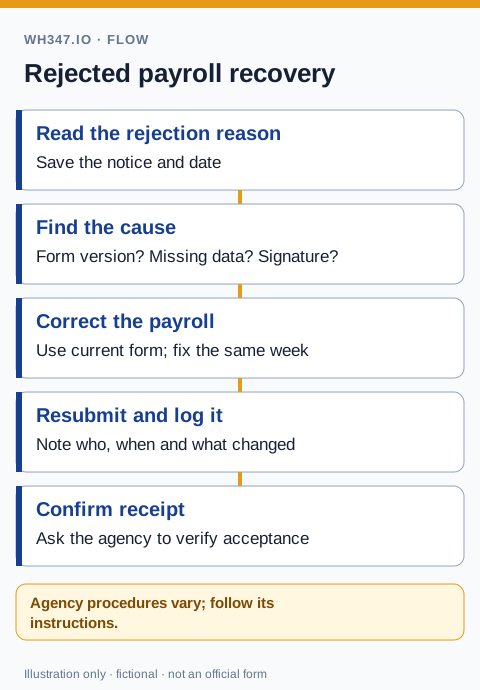
If an agency returns a report, use its stated reason rather than assuming an OMB-date rejection. Review how to document a corrected payroll and the prime's subcontractor reporting responsibilities. The withholding and payroll provisions are in 29 CFR 5.5(a)(2)–(3); they do not establish the form-expiration cutoff claimed here.
If you receive a rejection notice from a contracting agency because you submitted on the old form, the recovery process is straightforward:
- Generate the same payroll on the new form — same week-ending date, same data, new form template.
- Resubmit as quickly as possible — most agencies will process a corrected submission within their normal review cycle.
- Include a brief cover note explaining that the resubmission corrects the form version. This documents that the error was administrative, not substantive.
- Confirm receipt with the contracting officer or labor compliance reviewer and ask about payment release timing.
- Update your process immediately so subsequent submissions use the new form — don't wait to see if the next one gets rejected too.
The Subcontractor Liability Problem
As prime contractor, you are responsible for ensuring that all subcontractors on your project are submitting compliant certified payrolls. If a sub submits on the old form after October 1 and their submission is rejected, the resulting payment hold affects the whole project — not just the sub.
Notify your subs now. Five weeks is enough time for every subcontractor to update their form or software, but only if they know it's coming. A brief written notice this week — with the specific deadline and what to check — is the most practical thing you can do as prime to protect your project's payment schedule.
The Easy Way to Avoid All of This
WH347.io generates WH-347 PDFs using the current form template. Every submission generated by WH347.io today uses the new form with the updated OMB approval and Statement of Compliance language. If you're already a WH347.io user, you're already covered — no action required.
If you're preparing certified payroll manually or with a tool that hasn't updated yet, try WH347.io free. Five weeks is more than enough time to get your process transitioned before the deadline.
Frequently Asked Questions
What happens if a contracting agency receives a WH-347 on the old form after September 30?
The agency is required to reject it. After September 30, agencies cannot accept submissions made on the old form. Rejection means the payroll for that week is not recorded as compliant, which can trigger payment holds and create a gap in your project's certified payroll record.
Can an agency withhold payment because of an old-form submission?
Yes. Federal construction contracts give agencies the authority to withhold progress payments when certified payroll submissions are missing or non-compliant. A rejected old-form submission creates a week with no compliant payroll on file, which can result in partial or full payment withholding until a compliant resubmission is received.
Is using the old WH-347 form after September 30 a compliance violation?
Yes. Submitting on a form with an expired OMB approval number is a compliance deficiency. A single incident corrected promptly is typically treated as an administrative error. Repeated incidents or an unresponsive contractor can escalate to formal compliance findings.
How quickly can I recover if a submission is rejected for using the old form?
Recovery is straightforward: generate the same payroll data on the new form and resubmit as quickly as possible with a brief cover note explaining the correction. Most agencies process compliant resubmissions within their normal review cycle. Payment holds are typically released once the corrected submission is accepted.
If my subcontractor submits on the old form after October 1, does that affect me as the prime?
Yes. As prime contractor, you bear compliance responsibility for the entire project. A rejected sub payroll creates a gap in the project record that can affect progress payments across the project. Notify all subs in writing now — five weeks is sufficient time for them to update their process.