How Owner-Operators Report Themselves on the WH-347
— WH347.io Team
Ownership alone does not exempt construction labor from Davis-Bacon. Learn the business-owner management test, the narrow truck owner-operator policy, and what to confirm before preparing certified payroll.
A contractor who owns the business and also performs construction labor must determine whether that labor is covered before deciding how to report it. A sole-proprietor filing, LLC membership, independent-contractor label, or ownership of equipment does not by itself establish an exemption.
The Business-Owner Test: Equity Plus Active Management
DOL's Field Operations Handbook section 15f06 describes a bona fide exempt executive who owns at least a bona fide 20 percent equity interest in the enterprise in which employed and is actively engaged in its management. The rule applies regardless of business organization; its salary and salary-basis requirements do not apply to qualifying business owners.
Both ownership and management matter. The Handbook specifically says a person with at least 20 percent ownership who makes no management decisions, supervises no one, and has no personnel authority does not qualify. Payment through draws rather than wages is not a substitute for this test.
What to Document Before Claiming an Exemption
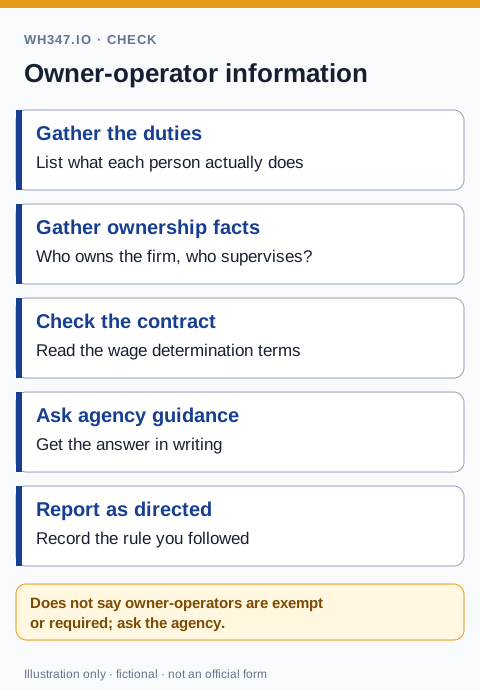
For a business-owner executive analysis, collect evidence of:
- A bona fide equity interest of at least 20 percent in the enterprise in which the individual is employed.
- Active management responsibilities, including actual management decisions and personnel authority where applicable.
- The individual's actual construction and supervisory duties, not just an officer or owner title.
- The contract's federal, state, and agency-specific coverage and reporting requirements.
- Written agency or WHD guidance where the facts or reporting treatment are unclear.
Do not automatically omit a sole proprietor, LLC member, or S-corporation shareholder who works in the field. Establish the applicable exemption on the actual facts. Separate state prevailing-wage rules may differ from the federal analysis.
Do You Go on the WH-347 or Not?
Report covered laborers and mechanics with their actual classifications, hours, and wages. For an owner who qualifies as an exempt executive, confirm the agency's documentation and listing requirements before omitting the individual. Do not use a generic 'owner-operator' notation to bypass the coverage analysis.
However, some contracting agencies want all individuals performing on-site work listed on certified payroll regardless of ownership status. Check your contract documents and, if unclear, ask the contracting officer in writing how to handle owner-operator labor. Get the answer documented before the first payroll submission — not after an audit inquiry.
Truck Owner-Operators Are a Separate, Narrow Policy
Handbook section 15e17 states an administrative policy for bona fide owner-operators of trucks who are independent contractors: certified payrolls include their names and the notation 'owner-operator' without hours worked or rates paid. This is not a policy of leaving them off the payroll entirely.
The Handbook expressly excludes owner-operators of bulldozers, scrapers, backhoes, cranes, drilling rigs, welding machines, and similar equipment from that truck policy. Employees hired by truck owner-operators remain subject to DBRA in the usual manner.
- Managing business owner: assess at least 20 percent bona fide equity plus active management under section 15f06.
- Independent truck owner-operator: assess the narrow section 15e17 policy and its name-plus-notation reporting treatment.
- Other equipment owner: truck-policy treatment is not available merely because the operator owns the equipment.
- Working supervisor: assess actual duties and any executive exemption; absent an applicable exemption, covered manual work requires prevailing wages and reporting.
Subcontractors Who Are Sole Proprietors
A sole-proprietor subcontractor working alone should not submit an empty payroll solely because there are no hired employees. First determine whether the proprietor's own work is covered, qualifies for the business-owner executive exemption, or falls within the narrow truck policy. The prime is responsible for obtaining required subcontractor certified payrolls.
Some primes require a statement from the sub confirming their owner-operator status; some contracting agencies have a specific owner-operator certification form. If you're a sole proprietor sub, ask the prime what documentation they need from you before the project starts.
When in Doubt, Get It in Writing
Read DOL's business-owner guidance in section 15f06 separately from its truck owner-operator policy in section 15e17. Before omitting anyone, confirm coverage with the agency or WHD; our subcontractor reporting guide and record-retention checklist help document the decision.
Keep ownership records, evidence of actual management duties, the coverage analysis, and any written agency or WHD guidance with the project records. A contract-specific reporting answer is useful documentation, but an owner label or agency form alone does not establish a federal wage exemption.
Frequently Asked Questions
Does an owner-operator have to appear on the WH-347?
Ownership alone is not an exemption. Assess the business-owner executive test of at least 20 percent bona fide equity plus active management. The separate independent truck owner-operator policy requires names and an owner-operator notation, without hours or rates. Confirm coverage and agency reporting instructions before omitting anyone.
What makes an owner-operator 'bona fide' under Davis-Bacon?
DOL Handbook section 15f06 describes at least a bona fide 20 percent equity interest and active management for the business-owner executive exemption. Section 15e17 separately addresses bona fide independent truck owner-operators. It does not extend to owners of backhoes, cranes, welding machines, or similar equipment.
How is a working supervisor different from an owner-operator?
A supervisor's actual duties and any applicable executive exemption must be assessed; neither a foreman title nor ownership alone decides coverage. Absent an applicable exemption, laborer or mechanic work must be paid and reported at the applicable prevailing rate.
What should a sole-proprietor subcontractor submit for certified payroll?
Determine coverage before preparing the report. Working alone does not justify an empty payroll. Report covered labor normally; use the narrow name-plus-notation treatment only for qualifying independent truck owner-operators. Obtain written agency instructions for an exempt business owner's reporting and documentation.
Can a small LLC member claim the owner-operator exemption?
LLC status alone does not qualify. The business-owner executive test requires at least 20 percent bona fide equity and active management, regardless of business organization. A member who performs construction labor without meeting an applicable exemption may be covered. Consult WHD or qualified counsel about uncertain facts.